Limited space is never an excuse — it’s just a creative challenge waiting to be solved.
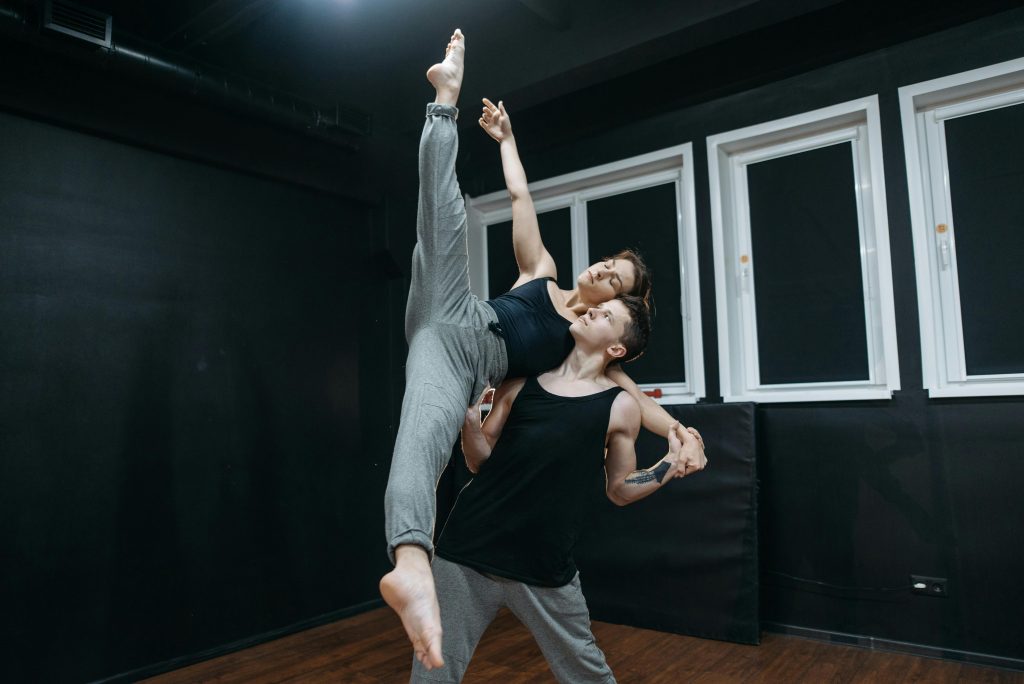
“You don’t need a grand stage.
Every great dancer started with just a few square feet.”
Not everyone has a spacious living room or a dedicated studio. Most beginner dancers — and plenty of experienced ones — are working with a bedroom corner, a small lounge, or a narrow hallway. The truth is, limited space doesn’t limit your progress. It just asks you to be smarter about how you use what you have.
Here are practical, tested tips for making any small space feel like your personal dance studio.
First: define your minimum dance zone
Before anything else, understand how much space you actually need. For most beginner styles — hip-hop, contemporary, classical isolations, and even basic Latin footwork — a clear rectangle of roughly 6 feet by 4 feet is enough. That’s about the size of a single mattress. Push back a sofa, roll up a rug, and you’re in business.
7 practical tips for small-space practice
Make it a habit to spend 3 minutes before practice pushing furniture to walls and removing trip hazards. A decluttered space mentally signals that it’s time to focus — and physically gives you every inch available.
Stick masking tape on the floor to define the boundary of your practice area. This trains your spatial awareness — essential for stage performance — and stops you from accidentally reaching into furniture mid-move.
A full-length mirror is your most valuable home studio tool. Even one leaned safely against a wall gives you real-time feedback on your posture, arm lines, and footwork that no camera replay fully replaces in the moment.
In a small space, you cannot run a full routine. Instead, break it into 4–8 count segments and drill each in place. This method actually builds cleaner technique than running full choreography at half-quality.
Some of the most impressive dance skills — arm styling, chest isolations, head rolls, hand articulation — require almost no floor space at all. Use tight-space sessions to master these details that dancers often neglect when they have room to travel.
A rooftop, driveway, quiet park corner, or empty car park gives you the travel space your apartment can’t. Schedule one outdoor session per week for full runs of choreography and larger travelling moves.
Prop your phone so it captures your full body from a slight distance. Review recordings right after practice while the movement is fresh in your body. Even one 10-minute review session per week can dramatically accelerate self-correction.
“Some of the world’s most technically precise dancers trained for years in cramped apartments. Space was never the barrier — consistency was the key.”
Your quick pre-practice checklist
- Furniture pushed back, floor clear of obstacles
- Dance zone marked with tape or a mat
- Mirror positioned or phone set up to record
- Playlist ready and volume set to energise you
- 5-minute warm-up planned before first move
- Water bottle nearby — hydration matters
Small space, big progress
Every limitation in your home practice environment is quietly building something in you — creativity, precision, and adaptability. Dancers who train in small spaces often develop sharper body awareness and tighter technique than those who always have room to spread out. Use your constraints as tools, not excuses.
And when you are ready to take your carefully honed skills into a full-size studio, you will discover that all those hours in your small home space have quietly built something remarkable.
Leave a Comment